> For the complete documentation index, see [llms.txt](https://faq.trackdechets.fr/llms.txt). Markdown versions of documentation pages are available by appending `.md` to page URLs; this page is available as [Markdown](https://faq.trackdechets.fr/dechets-dangereux-classiques/informations-generales/cycle-de-vie-du-bsd.md).
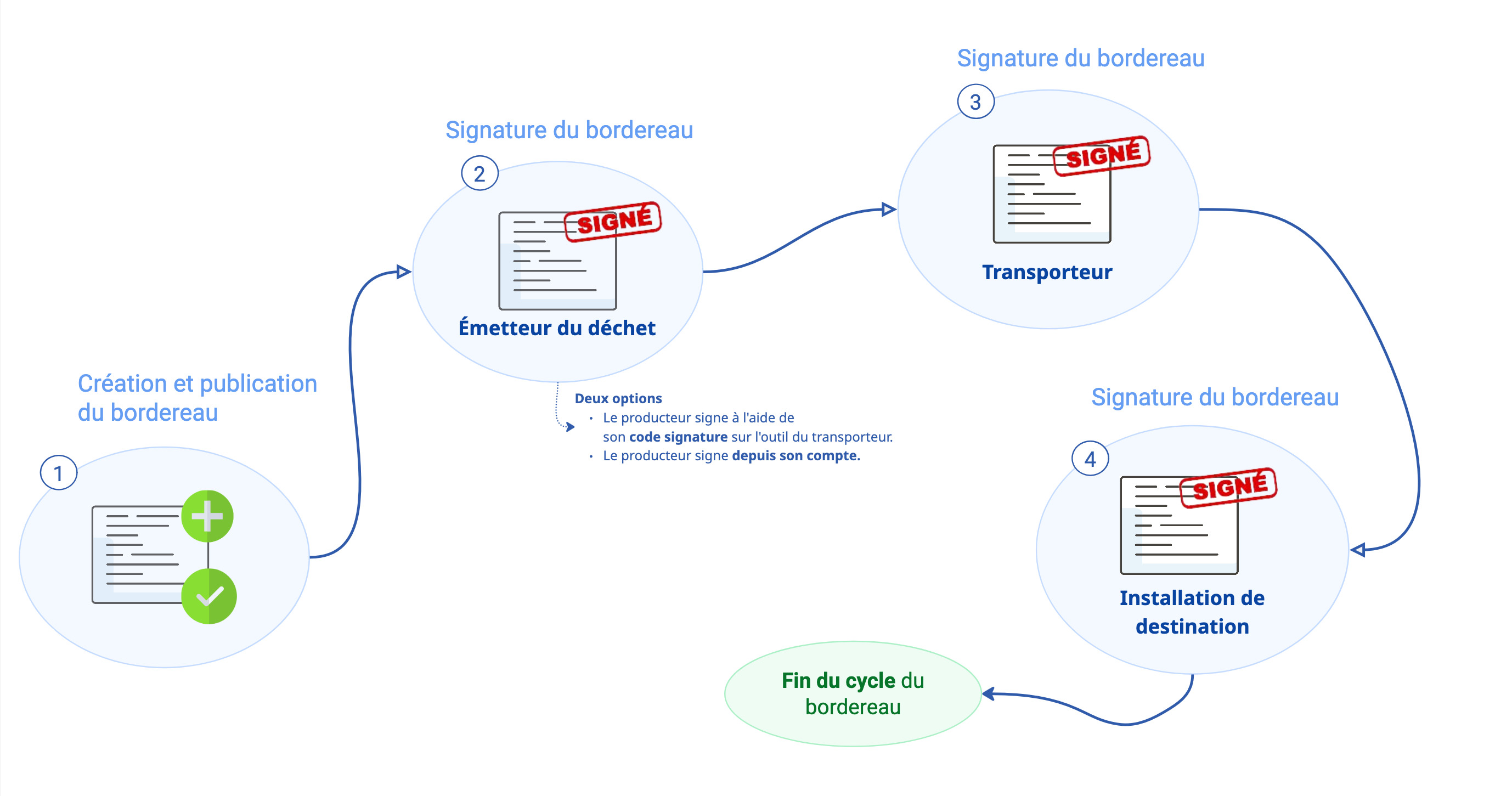
# Le parcours du BSDD initial
Les principales étapes du parcours d'un bordereau de suivi de déchets dangereux simple
Le parcours d'un BSDD simple (sans étape de tri, transit & regroupement)
### **Vous pouvez consulter la formation dédiée au cycle de vie du BSDD**
{% embed url="" %}
{% columns %}
{% column %}
{% content-ref url="/pages/-M0T2-ai35RD9GInZyh7" %}
[Créer un BSDD](/dechets-dangereux-classiques/informations-generales/cycle-de-vie-du-bsd/ledition-du-bsd-sur-trackdechets.md)
{% endcontent-ref %}
{% endcolumn %}
{% column %}
{% content-ref url="/pages/0jMZQGWUqKrZM873EBD4" %}
[Signer un BSDD](/dechets-dangereux-classiques/informations-generales/cycle-de-vie-du-bsd/signer-un-bsdd.md)
{% endcontent-ref %}
{% endcolumn %}
{% endcolumns %}